Joining our group
Thank you for your interest in our group. I receive many requests each year, and this volume means I can't reply to each one individually. This page provides the general information and advice I would otherwise send, and helps you plan and judge your realistic options.
Most PhD positions in our group are funded by grants. When we advertise a PhD, we post the opening publicly through the university and on LinkedIn. If you want to work with us, the most likely route is to apply to one of these openings when it appears.
External funding
The alternative is to bring your own funding. There's no easy path, but if you find a plausible grant or fellowship, for example through a national science foundation in your country, write up a draft research proposal and send it to me. If it's a good fit, I may collaborate on the plan and write a letter of support. Fit with our research program is essential. At my university, a four-year PhD project costs close to half a million euros. I apologize that there aren't more opportunities.
A polished letter of interest no longer tells me much. Applications increasingly read the same way, which I take to mean most are edited with AI tools. That's fine, and I'd expect you to use the tools available to you. But it means the letter itself is a weak signal. Writing to me individually is worth your time only if you can show three things: directly relevant skills (environmental social science, quantitative methods, behavioral intervention, and the like, rather than fields such as mental health, wellbeing, or architecture), evidence you understand what we do (feedback on a specific paper, a concrete research idea that fits my recent work), and a clear route to funding. If you don't have all three, you are welcome to apply to one of our posted openings.
Should you get a PhD?
There are good reasons to do a PhD, and it can be a rewarding and fruitful experience. But I don't recommend one if the main motivation is to become a university professor. Do a PhD because it aligns with your values and goals and provides useful training, not as a route to a faculty job.
The academic market is competitive and getting worse, with higher education leaning more and more on adjunct instructors. PhD graduates do find jobs, often in academia, but only a very small share go on to tenured research professorships at top schools like the ones where they trained, perhaps 1% (setting aside other kinds of institutions and teaching or administration contracts). Even a successful research trajectory usually means moving around the world for modestly paid post-docs, straining relationships, and time away from family. These have been hard on me. Being smart, capable, and hard-working isn't enough; you also have to be lucky. So it's a difficult plan, but it can work if you're geographically flexible and driven by real passion, purpose, and skill. That's a bleak picture, but you should know what it looks like from the other end, and many faculty won't have this uncomfortable conversation with you. It's worth considering roles in academia, and other kinds of teaching, that don't require a PhD.
That said, higher education in psychology remains a great plan. The subject matter is engaging, because everyone wants to understand, predict, and influence others. A psychology MSc or PhD can combine data science and behavioral insight in ways that are employable, especially if you build strong quantitative and communication skills. There's a lot of meaningful work in industry and government: interventions, policy, communication, and other people-focused projects. When choosing a degree and a program, look hard at how much the curriculum builds employable skills rather than just producing research papers. You'll also meet parts of contemporary science that are broken and frustrating: the noisy way scientist quality is judged, a publishing model where scientists produce the content and then pay to read it back, and outmoded incentives that reward distortion and opacity. Some students decide they can't support a system with these problems, and if that's you, take your skills somewhere you can serve with pride and purpose. There's a lot to enjoy in academia, but most PhDs end up in industry, and many of those careers are satisfying, useful, and some are more stable and better paid. If you have feedback on any of this, let me know at c.brick@uva.nl.
What are the chances of an academic career in the Netherlands?
See how much PhD positions have increased compared to the Dutch academic jobs that produce them. This means there is a big disconnect between how many people are being trained, many of whom want to work in academia, and how many jobs there are.
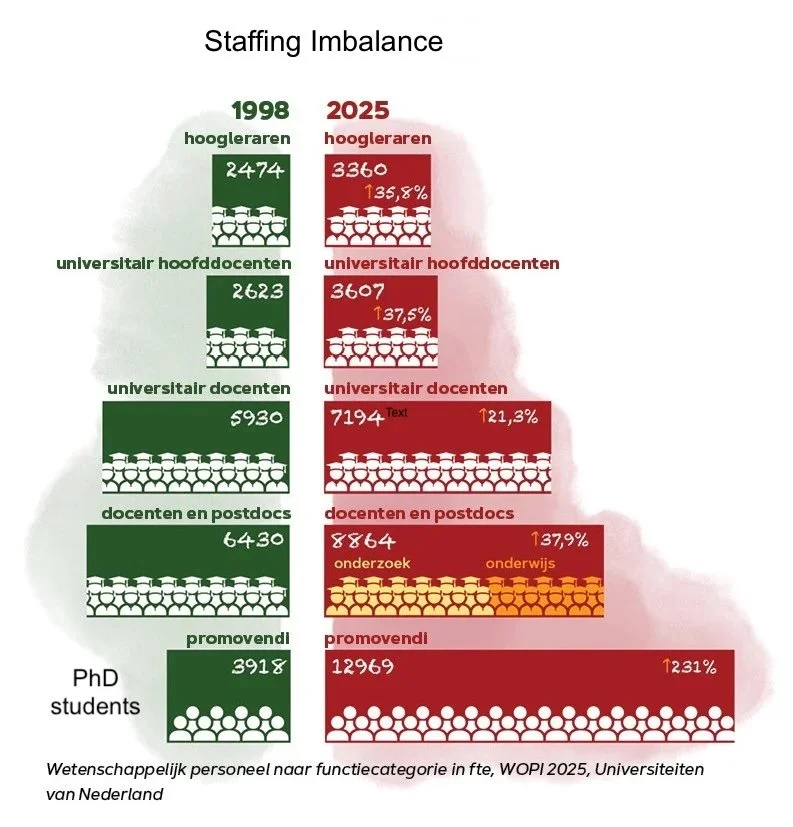
Next, what are your chances of making assistant professor in the Netherlands after earning a PhD? Not great: the majority of PhDs get jobs outside of universities during or after the PhD, or after a postdoc or lecturer position (see below). More assistant professors leave academia or retire than get promoted further. However, some of these candidates never intended to stay in academia.

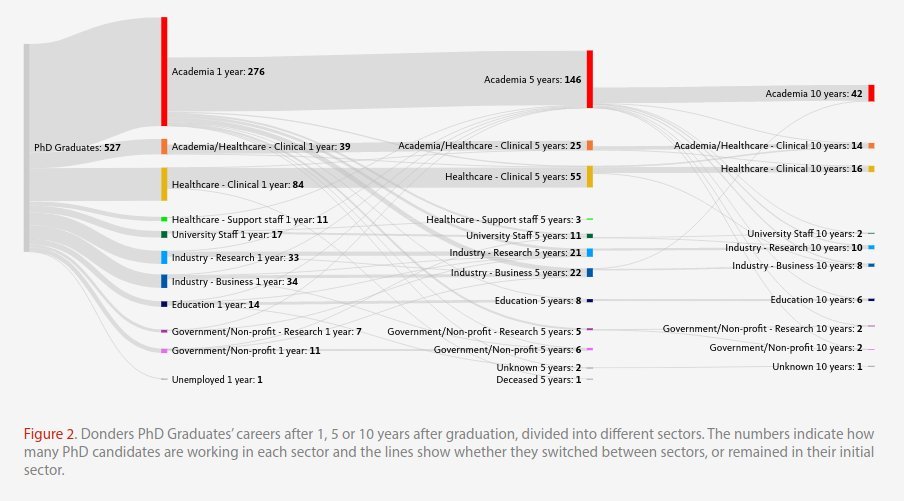
Next, see this next chart from the Donders Institute (NL), explaining where PhD graduates end up after 1, 5, and 10 years. There is a lot of missing data in both these graphs. If you have any newer ones, please tell me.
Academic Career Advice
After PhD
The Professor is In — book with advice
There are some jobs in environmental psychology each year. I share everything I see on LinkedIn.
To get a research postdoc, it is ideal but rare to get your own funding, and then you can pick where to work. Otherwise, I'd recommend making a list of scholars of interest (feel free to use my list and add to it) and write them personal emails to ask about opportunities or solicit grant co-investigators. I was unable to secure a postdoc after my PhD and went into a teaching-heavy job. In general, read disciplinary mailing lists and consider social media posts to relevant communities. In environmental psychology:
IAAP Division 4
National EnvPsych Association mailing lists (DGPs Fachgruppe Umwelt & IPU in Germany/Austria/(I think Switzerland has one?), PsicAmb: (Spanish-speaking), Norsk miljøpsykologisk nettverk (Norway), more?)
To get a faculty job, consider teaching-heavy roles and related disciplines. Don't hesitate to apply for teaching jobs in departments of social psychology or environmental science or interdisciplinary groups (e.g., schools of public policy). All might be interested in your training and skills, even if their call doesn't mention it. You can also write brief inquiries to job openings to talk about those kinds of fit issues (include your CV). Also, write a killer teaching statement (e.g., with concrete examples rather than broad statements of values) and revise it a lot.
Grants and Fellowships
https://www.researchprofessional.com
https://www.academictransfer.com
Seriously consider non-academic positions in behavioral change and environment, such as government and NGO. Most people dismiss these paths too quickly, in part because they haven’t met people doing those jobs. I am not sure I would choose the same career again if I'd known how narrow the opportunities are in academia. Develop a LinkedIn profile and start asking people adjacent to your training for advice. Look for people you trained with that are no longer in academia. CVs should turn into much briefer resumes focused around specific skills. When I was considering this more heavily, I easily found strangers online who were happy to talk about it. And good luck!
Outside Academia
Vacatures - Werken voor Nederland (RIVM)
Behavioural Insights Network Netherlands
unjobs.org (not just UN)